Your cart is empty

Only use a professional if you need a specialised risk assessment. A daily check by staff is more relevant, cost effective, engages staff and promotes self-responsibility.


Hazard Vs Risk Review

A hazard review is a process of identifying potential hazards in your workplace.

Risk Review or a Risk assessment is a formal assessment of that hazard and how likely it is to result in actual harm.

The process is:-

  • Identify hazards
  • Risk assess so you can prioritise which ones need attention first
  • You fix the problem, or take action to reduce the risk

Simple example to illustrate stages:

  • Hazard: We spot a loose corner on a carpet
  • Risk: Someone could trip and injure themselves
  • Immediate action:. We tape it down as a temporary measure, this minimises the risk
  • Fixing the problem: Tradesman fixes the loose carpet, this eliminates the risk

Actual Vs Potential harm

A hazard is something that is likely to cause harm, and a potential hazard is something that might cause a harm, the key difference being "likely" Vs "might".

This might be obvious to most managers, but when staff don't understand the difference, they tend to overlook potential hazards.


Who's responsible

The smart answer is that "We are all responsible" and our own safety depends on the actions we take or issues we ignore. The theory and practice often differ, and it is not uncommon to find everyone thinking someone else is taking care of it.

Legally, it is the responsibility of the employer to establish a set of safety standards and procedures; provide the tools and equipment to keep people safe; and provide adequate training to staff.


External contractors Vs In-house

External contractor come in at fixed intervals, whereas your staff are experiencing the risk every single day.

It is far more effective that staff are taught to be aware and observant of potential risks, and in the critical place to spot, prevent and avoid the risk in the first place.

Most routine business activities can be monitored in-house in a cost effective manner.

An external contractor is only useful where specialist knowledge and expertise is required.


Workplace Risk Assessments and Hazard Reviews

These are just jargon to describe a formal approach to the thinking about what could go wrong even with every day actions such as the risk of getting scalded when putting on a kettle or tripping over toys lying on the floor.

The tools you need are:-

  1. Common sense
  2. Being observant
  3. Taking action

Employer's liability claims

An employer's liability claim requires the employee to demonstrate a breach of duty of care.
This is usually when you are in contravention of any government guidelines or advice regarding safety at work or travel.

Examples:-

  • Sending an employee to an area affected by the safety issue
  • Not providing essential equipment or guidelines
  • Making an employee come to work after exposure and infecting others

Avoid this risk by having up to date risk assessments and up to date safety guidelines.

Daily Safety Reviews

Teamwork reduces risk, and all staff need to be trained to be observant and proactive in spotting and fixing hazards around them.

Your biggest asset in spotting hazards and minimising risk are the people closest to the task, as they have the most intimate understanding of what can go wrong.

The most common failing is a lack of Daily Safety Checks by staff


Explaining Risk Reviews to staff

Many people feel unqualified to carry out risk assessments.

Here is how you can overcome this:-

As this question at a training session: Have you crossed a road in the last few days?
Usual answer will be "Yes"

Then explain this in risk assessment terms:-

  1. This is what you did. You checked the crossing and traffic lights, looking left and right for traffic
  2. Then you crossed the road when it was safe
  3. This was the biggest risk assessment you could have done because your life depended on getting it right.
  4. You do risk assessments like this every single day, even able to teach a 5 year old, but we don't think of it as a formal risk assessment.

Everyone, who hasn't been run over by a bus, is capable of doing such risk assessments


Gamify Hazard Reviews

Walking around to look for loose cables and trip hazards is not the most exciting of tasks for staff.

Mundane tasks can be turned into something more interesting with an element of fun and competition.

Get a large box of chocolates and let people win chocolates based on the number of hazards they spot, with special prizes for fixing things on the spot and the "best hazard spotted".

This is more than a fun competition, what you are achieving is building team spirit, participation, and common sense of responsibility without having to be "managerial".


Check Your Insurance

You are vulnerable to claims if you did not take reasonable precautions or you acted in a negligent manner with regard to safety.

Check your insurance in these key areas:

  1. Public liability : Your liability to the public
  2. Employer's Liability: Your liability to your employees
  3. Professional/Medical Liability: Care liability for malpractice or negligent treatment
  4. Business interruption: Disruption or closure due to unexpected events

Risk in making an insurance claim

  1. Your excess per claim might not make it worth making a claim
  2. Your premium may be increased next time
  3. Your insurer may decline to renew next time based on claims history

Note: Care Homes are increasingly seen as high risk and many insurers are looking for a reason to get out


Effect of COVID on Insurance

Most likely COVID related claim types:-

  • Business Interruption
  • Negligence/Infection due to

Be aware of staff being able to claim against you for them getting infected in the workplace.
Don't expect a business interruption claim to be easy, most insurers are refusing claims due to "Forced closure of business by authorities"

Post-COVID Insurability Risks

  1. Care homes and Domiciliary care are increasingly at risk of being refused cover
  2. Many insurers are refusing COVID cover for Public and Employer's liability
  3. If you are formally refused cover, you will have immense difficulty getting any cover from anyone else

Add extra focus on prevention measures, daily safety and reasonable precautions


Instant Solution: Risk Assessment

Go to My Toolkts and look for these under Evidence Toolkits (Section 6 - Safety)

  • 6 Hazard Management
  • 6 Hazard Reviews

These Toolkits help identify Hazards and Risk Assess your findings

HSE logo
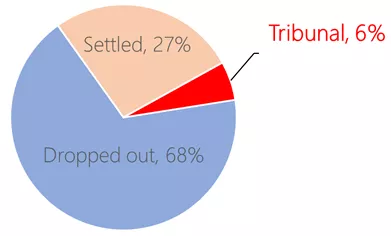
  • 94% of claims never reach tribunal stage
  • 27% of disputes are settled out of court
  • 68% of the cases are "empty threats"
Acas tribunals

Fear of Tribunals

  • 94% of claims never reach tribunal stage
  • 27% of disputes are settled out of court
  • 68% of the cases are "empty threats"

Acas tribunals

"FEAR SELLS"

Don't make your decisions based on fear

Based on Acas statistics


The Real Costs of a Dispute

Legal costs are at the top of everyone's mind in a dispute, because it is easy to visualise having to write out a cheque.

You might find that there are more serious costs than just cash:-

  • Time consumed in gathering paperwork, emails and other evidence for the legal team
  • Internal meetings to go through the facts
  • Preparing for tribunal hearing
  • The stress of thinking about this every day
  • Effect on staff morale

Expect to spend a lot of time

Disputes tie up the time of your most senior Managers, Partners, and Directors.
The longer it goes on, the greater the drain on everyone.
Be realistic about your reasons for the dispute, and how far you are prepared to go.


Legal Protection Insurance doesn't cover everything

Legal protection insurance is not like car or house insurance, it is not as straightforward as you might think.

Will I be covered for all claims

  • There is no guarantee your claim will be covered, it has to be assessed by them first
  • Insurer has to be satisfied you have a reasonable chance of winning, else you don't get cover
  • They can drop your case at any time if they feel your chances of winning changes
  • The insured person might be the intermediary, not you. This means they decide which lawyer to appoint

Things to watch out for

  • Who is insured you or the intermediary/supplier. What happens if the intermediary goes bust
  • Is there an up front charge or excess when you make the claim
  • Are you covered for everything including damages and other party's legal costs
  • What happens if their advice is wrong and it has cost you
  • What happens if you're not happy with the lawyer, can you switch to your own lawyer

Following the Process

  • You must notify the insurer before taking any action
  • You need to get their go ahead before you do anything
  • You must follow exactly the advice given by them, your cover can be dropped if you don't

Fair dismissal

It's all about the process
You can dismiss people, as long as you follow a fair and reasonable procedure. You might have a valid reason, but if the way you do it is unfair, you risk a claim for unfair dismissal.

Reasons for fair dismissal:

  • Poor conduct
  • Poor performance/capability
  • Redundancy
  • The law does not allow the employee to do that job
  • A substantial reason such as end of contract or refusal to agree to new terms of employment

HIGH RISK LEVEL: Employers routinely skip a fair Performance Review


Unfair Dismissal

A dismissal is automatically treated as unfair if the main reason is being pregnant or on maternity leave; wanting to take family leave; for being a trade union member; asking for a legal right; whistleblowing; they're taking action over a health and safety issue.

Around 50% of Employers lose a case because they did not follow a fair and reasonable procedure.

  • The biggest risk to employers comes from not following a full and fair procedure
  • You could have a perfectly valid reason to dismiss, but lose because you did not follow a fair and reasonable procedure

MEDIUM RISK LEVEL: If you follow the process, your case may not even reach the dispute stage


Constructive dismissal

This where an employee resigns because they felt that they had no choice but to resign because of something very serious the employer has done. The legal term is 'constructive unfair dismissal'

  • This could be things like regularly not being paid; being bullied; being discriminated against; their grievance not being investigated; unreasonable changes employment without agreement.
  • It could also be just one incident or a series of things.

Risks:

  • The biggest risk arises out of not following good employment practices and not following proper procedures.

Reality:

  • The employee must have worked for you for two years to be able to file a claim
  • Proving Constructive Dismissal is extremely hard, needs legal advice and is costly for the Employee
  • This is a low risk for most smaller organisations and very unlikely in normal circumstances

The most sensible approach is to follow good employment practice to avoid disputes and be prepared to settle this amicably where you can before it gets out of hand.

LOW RISK LEVEL: Extremely hard to win these claims, most small claims never reach this stage


Breach of Contract

This can be deemed as a low risk because it usually arises out of an Employer's actions, which they are in full control of.

Disputes under breach of contract usually involve unpaid wages and unauthorised deductions, or other issues such as holiday entitlement.

When issues are related to administrative and accounting, rather than people and performance related, this is almost entirely under the control of the Employer and easily avoided.

In relatively rare cases, the Employer may deliberately withhold payment due to a genuine dispute, but otherwise this can be avoided by having reliable admin processes, good communication, and well drafted employment contracts.

LOW RISK LEVEL: More common but mostly low value claims, easily preventable with robust procedures


Sex & Race discrimination

If you are a good employer following good employment practice, there is virtually no risk to you. You should only fear this if:-

  • You are not following good employment practice
  • You are not proactive in training people to be aware of these issues
  • You are not observant about how staff behave
  • Your staff cannot approach anyone to discuss these problems
  • You do not take appropriate action when this is reported to you

You are always at the risk from poor behaviour of some staff, but you can mitigate this if you follow best employment practice and staff know they can trust you to deal with this fairly, firmly and effectively.

HIGH RISK LEVEL: Political hot potato, low incidence level but high claim value and likely to trend


Whistleblowing

Very high risk in CQC regulated Providers

Probably the most underestimated risk for CQC Registered Services as it is more than a "cash penalty", it has the potential to lose your licence to trade and close down your business.

These are all from actual cases we have encountered:-

  • Management failures: Legitimate whistleblowing of poor management
  • Unfounded allegations: Spiteful reporting by disgruntled staff
  • Self-Reporting: Incompetent staff whistleblowing on their own failures
  • Sabotage: Removing or deleting crucial records, then reporting to CQC as failures

HIGH RISK LEVEL: Low incidence but very high risk. Focus on a robust culture not just systems


Whistleblowing Vs Grievance

Whistleblowing can often contain elements of Grievance and it is important to distinguish between the two as the process is different for each

The basic legal position is set out below, however best practice and your policies usually give employees more protection and rights than minimum legal requirements.

WhistleblowingGrievance
Risk to others – raising concerns about wrongdoing, risk or malpractice that you witness Risk to self – typically about how you exclusively are being treated and not the treatment of others
Public interest – public interest, may not even affect you, but will have wider implications on the public Types of issues – about things you are asked to do about your job or how you are treated
Process – there is no set process for investigating whistleblowing, but there is good practice guidance Process – ACAS has set out Codes of Practice in relation to discipline and grievance procedures
Confidentiality – your employer should respect your wish for confidentiality.  
Feedback – you may never know the outcome of a whistleblowing concern Outcome – about a legal outcome, an apology, a payment due, or change to the working practices
Appeal – there is no general right to appeal Appeal – you have the right to appeal
There is also no right to be accompanied to a meeting Support – you have the right to be accompanied


Policies Customisation Services


When a generic policy does not cover special circumstances of your organisation, you might need to make changes to customise that policy to your requirements.

You might use Customisation Services to make limited changes only, to edit or add special clauses to your existing or generic policies, or for wholesale redrafting of all your policies.

Customisations Adds Costs

  • Any customisation needs regular reviews to ensure relevance and that edits remain in line with changes
  • Extensive customisation results in increased maintenance
  • Wholesale customisation is a long term decision. You may become tied into or reliant upon that service for updates, regular monitoring, and maintenance.
  • Take into account your ability to easily take it in-house or switch to another service.
  • Limit changes to specific policies only where possible

Verify the Supplier's reputation and reliability


Contract of employment

What is an Employment Contract

  • There is no legal requirement to have a written contract, it can be verbal
  • Terms can be implied if not agreed e.g. "don't steal from us" or "we will keep you safe"
  • Terms can be in the employee handbook, or on the Staff Noticeboard
  • Terms can be in the offer letter
  • Most of the basic Terms of Employment are already dictated by legislation

Written statement of employment particulars
An employer must give employees and workers a document stating the main conditions of employment when they start work. This is known as a 'written statement of employment particulars'. It is not an employment contract.

In summary, this statement will include basic details such as the person's name, wage, hours of work, holidays, place of work, length of employment, probation, benefits and training.

Click HERE for a free Template from ACAS

Contract of Employment

  • You should always have a written Employment Contract, with the Terms of Employment clearly defined
  • A clear contract lays out responsibilities and commitments and will avoid unnecessary disputes
  • This allows an opportunity for the Employer to clarify key terms; include additional clauses; and ensure that everything is covered

Legal Advice lines

Employers often feel the need to have the backup and comfort of independent advice in case we encounter a problem requiring specialist knowledge, dealing with complex cases, or avoiding disputes.

Member Services

Professional Bodies often provide advisory services as a membership benefit. This should be your first port of call because of their intimate knowledge of the industry; being better versed in any special requirements in your profession; and being aware of potential regulatory and legal indemnity issues.

FREE Resources

Acas gives employees and employers free, impartial advice on workplace rights, rules and best practice, and also offer training and help to resolve disputes through mediation and dispute resolution services.


Legal Protection

Legal protection guarantees come in two broad forms

  1. Self-cover: the advisor guarantees their time and advice
  2. Insurance-cover: An insurance policy covers your costs

By self-cover we mean that the advisor guarantees the protection themselves; covers their own time and costs; does not involve third parties. Think of this as going to a lawyer who guarantees their work no matter what, and if they mess up they would pay to correct the problem.

By insurance-cover we mean that you or your advisor takes out an insurance policy with an insurer that covers your claim.
This can take several forms:-

  • The advisor provides the service with an insurance backing - They are insured
  • You go direct to the policy/insurance provider- You are insured
  • You are redirected by the advisor to another advisor/layer who acts under that insurance policy - They are insured

Why legal protection sounds attractive

Fear of the unknown is the main driving force for legal protection:-

  1. Tribunals: What if I have to go to tribunals, who will represent me, how much will it cost
  2. Fear of disputes: How will I handle it, I'll need a lawyer/expert
  3. Cost: Lawyers cost over £100 per hour, barristers even more, this protection gives me peace of mind
  4. Time is money: I can just hand it over to the advisor saving me a huge amount of time
  5. Tribunals: Never have to worry about tribunals, they'll defend me, cover my costs

Most of these fears are unfounded. 94% of cases never make it to tribunal stage, 27% are settled and 68% are just dropped (See the myth-busters section)

You can still opt to have legal protection, but you should be better informed and better prepared with what questions to ask and what you are getting.

How do I get rid of someone?

This is the most natural approach when Employers want to be rid of an employee.

It is not a healthy approach as it puts you in the frame of mind of "the end justifies the means" with the temptation to ignore the fair process, and the unpleasant surprise of losing despite being right.

The rules to follow:-

  • Follow the Fair and Reasonable process
  • Act professionally at all time, it will help you in court and negotiations
  • Act ethically, it will help your case
  • Ask how you got here, fix any systemic problems
  • Put in prevention measures for any complaints raised

Make commercial decisions

Disputes tend to tie up your best people in this stressful and time consuming task.

  • Disputes can easily become personalised because the accusations invariably involve individuals who are at loggerheads.
  • Avoid the disputes getting polarised and positions becoming entrenched
  • Avoid letting it become acrimonious and more difficult and time-consuming to resolve
  • Employees usually have more time to spend of this than you do

Commercial Approach

  • You have the right to be robust in articulating your position and protecting your rights
  • If the situation is likely to get intractable, consider the cost Vs benefit and whether it might be better to put a halt to this
  • Keep evaluating your commercial position "Is it worth my time and stress to take this to tribunal?"

If it gets protracted, don't lose sight of the fact that at some stage it might be more important to resolve this rather than winning, even if you have to give in and pay despite being right.

Employers who have experienced a protracted and acrimonious dispute often lament how much cheaper it would have been to just settle and move on.


Follow the process

The Disciplinary and Grievance process is embodied in "The Acas Code of Practice on disciplinary and grievance procedures".

This is the minimum an employer should follow for handling these issues in the workplace. Employers who do not follow this process are at a higher risk of losing their case in a dispute.

A common misstep is for Employers rushing to the goal of firing the employee without due process and their right to reply. One of the key steps that is often missed when the person's competency is under question is a fair Performance Review.

Acas publish comprehensive resources as part of their service, with two powerful tools at your disposal:-

  1. FREE guides, documents, and templates on their web site
  2. FREE telephone advice and friendly guidance

Turn Personnel Development into Employer Protection

The time you invest in Staff Development might be vital evidence in a dispute.

  • Keep a comprehensive record of Personal Development, Appraisals, and Staff Meetings to demonstrate that you are a good employer.
  • More importantly, keep a record of staff feedback and personal discussions to show that staff were given the opportunity and a platform to speak freely about issues of concern.
  • A Staff Appraisal with feedback is an important evidential record that the person appeared perfectly happy with the job and their environment at that time. If you record and act on the feedback in a diligent manner, that would further demonstrate that you follow a fair and reasonable process when appropriate.
  • Most staff will have stated at their appraisal that they are happy with the appraisal. This is vital evidence assuming this was a free expression without undue pressure or intimidation.

Using Standard HR Policies

You might not need to customise anything

Standard HR Policies are usually sufficient, particularly for smaller organisations. Look for suppliers who specialise in your profession as it makes more sense to get your core library from a reputable supplier and build on that.

  • Customisation should only be necessary if this would better reflect your circumstances.
  • It may be more cost effective to use the services of the same supplier to customise, for consistency and reliability.
  • The basic principle to follow is to start from a recognised source for Best Practice and customise and improve only where required.

Step 1 - Action plan

  1. Get yourself organised by allocating time to do the job and making sure key members of staff will be available to assist at that time
  2. Prepare yourself as to what do you need to do for CQC. Read the regulations, get toolkits to help (BMA has a very good toolkit, see the Resources section if you haven't already got this).
  3. Prepare GP partners for CQC
    1. What expenditure they might have to authorise for tools or staff
    2. How this is to be enforced – You need their absolute authority and support to tell staff what to do. This is now a fundamental part of your job and you will have to be prepared to issue warnings to non-cooperating staff.
    3. Make sure they understand that they are now personally liable for registration, even though a manager might be doing the legwork.
    4. They are aware of the penalties and criminal liability for non-compliance
  4. Prep your staff about the registration and new requirements
  5. Work out a time table for implementation
  6. If you have bought a complete set of tools to do this, it should take you 2-3 months to get everything done
  7. If you are designing everything yourself, this will depend on how well organised you are already. Allow 1-2 months to bring your systems up to scratch and 2-3 months to implement.

An alternative method of organising
A good way of working your way through is to concentrate on high risk items first and work your way through to lower risk items. This way, if you do not have time to get everything ready by the deadline, whatever is left to do is relatively low risk and does not reflect on your application too badly.
We recommend this method, and the sequence you could adopt is:-

  1. Premises
  2. Equipment
  3. Fire and environment
  4. Staff Management
  5. Patients - Outcomes
  6. Corporate governance

Step 2 - Update your policies

Policies are your adopted rules and intent.

Although we say that CQC is not about policies, that does not mean you don't need any. Policies are an essential first step in planning our system to decide what we are aiming for. However, this is just intent and unless you put it into practice, it has little value.

So treating this as a first stage of deciding what standards we will hold ourselves up to, it is a good idea to make sure that all policies are up to date and in place. Most practices should find this step quite easy as this is a familiar routine and they are likely to have done this exercise for QOF and contract reviews.

And remember - There aren't any special policies for CQC, your existing ones are probably fine


Step 3 - Update protocols

A protocol, process or procedure describes how we will make the policies work. At this stage you need to ensure that you have worked out what the staff members have to do to make sure we meet quality standards.

Essentially these are the steps we will follow to make sure that we meet our policy objectives. Here is how policies and processes fit together:-

Policy
A policy might read something like "Our policy is to maintain strict fire safety precautions and ensure all staff are aware of how to deal with ...... etc."

Process
These are some of the processes required to put this in practice:-

  • Carrying out regular risk assessments
  • Daily safety checks to ensure safety is maintained, for example that fire doors are not inadvertently blocked
  • Regular fire drills
  • Testing alarms and fire systems on a regular basis

Evidence

  • Written copies of risks assessments and actions taken
  • Daily checklist completed, signed, and reviewed
  • Log of fire drill activity
  • Log of alarm tests

Even if you have protocols in place, you should review the BMA guide to CQC, which includes pro-forma protocols for each of the outcomes. See the resources section for links.


Step 4 - Plan the roll out

Once you have got the policies and procedures in place, and you are now ready to implement these and get things done.

Start by organising, scheduling and allocating routine tasks which need to be carried out daily/ weekly/ monthly/Annually.

Allocate the duties for each of the main areas, here are examples:-

  1. Daily safety checks rotating between staff where possible (this builds in redundancy and trains different members of staff at the same time)
  2. Daily infection control checks. Allocating checks for cleanliness to members of staff reinforces good practice and raises awareness.
  3. Daily security checks.

Rotating duties between staff members reinforces important safety messages, and makes them more aware of the issues. This type of training ensures that if you are inspected, each member of staff is able to demonstrate intimate knowledge of the principles as opposed to having to regurgitate what they read in a handbook 6 months ago.


Step 5 - Get staff onside

A fundamental problem in GP practices is that the entire burden of compliance falls on the practice manager's shoulders. Once staff gets into the frame of mind that "this is not my job" and push it on to the manager, the practice manager is forever stuck in this cycle where they feel they have to do everything, else it just doesn't get done.

Hopefully you might not have this problem, but if you do, here is a suggested agenda for how to get staff organised. This will be a tricky area as some staff may oppose change, but you need to be firm because if any member of the team does not pull their weight, the whole system suffers. If you do not take a firm stand, the end result will be that the task will end up on the manager's desk again.

  1. Give a written notice to staff about the coming changes and their role in the daily compliance regime
  2. Send a memo/guidelines about self-responsibility – The whole ethos is about self-responsibility and you cannot now leave everything to the PM. Everyone has to be competent or there is no practice and there is no job.
  3. Here are the new rules:-
      1. Our licence depends on this, so everyone has to go through training
      2. Staff need to be aware of things + need to be knowledgeable to do their jobs
      3. Competency & suitability tests now compulsory – if you cannot do the job, we are not allowed to let you do it
      4. You will have to go through a training process
      5. You will have to go through self-certification else we cannot let you log on to system and you cannot do your job:-
        1. IG Toolkit
        2. Caldicott rules and importance of confidentiality
  4. Your duties have to be modified
  5. Patient care/safety/outcomes is the most important theme – everyone likely to come into any contact with patients [including admin staff answering the odd call] must go through training and must follow the rules
  6. Allocate protected time to get things done
  7. Issue new contracts to staff
  8. Publicise the policies and processes – make sure everyone knows so there is no dispute afterwards

Step 6 - Train everyone

Steps 1-5 were the easy bits. Setting up the rules is one thing, but putting these into practice is time consuming and can be challenging as you will be dealing with staff of varying abilities and attitude.

What we want to achieve:-

  1. Ensure that every member of staff is covered.
  2. Staff has the opportunity to have repeat training if they don't understand.
  3. That staff actually understand the content, and not just attending as a tick box exercise.
  4. Create "champions" in the team whom the staff can go to at any time. Might just be one person in a smaller organisation.
  5. Teach them how to teach. If they can teach others, generally they must have understood the subject well, and it saves you time.
  6. Rotate jobs, even for short periods, so staff learns how everyone's jobs fit together and broadens their knowledge and understanding.

Types of training:-

  1. Informal one to one meetings.
  2. Structured one to one training.
  3. Briefs at staff meetings.
  4. Structured training at staff meetings.
  5. External courses.
  6. Vocational training
  7. Recognised qualifications.
  8. Online training.
  9. In job training.

Evidence of training - Make sure you keep evidence of who was trained and when. As well as being able to prove that training was carried out, nothing speaks louder than the impact it has on improving performance. One training session with demonstrable evidence of improvement is more powerful than 10 sessions with no improvement.

Types of evidence:-

  1. Names and dates of attendances
  2. Acknowledgement of attendance by trainee
  3. Feedback on what they learned

Step 7 - Implementation

This is the most underestimated step of all. On average, a manager can spend up to 80% of their time implementing a system.

What do we mean by implementation?

You have designed the system and trained everyone on what to do.

Now you have to make them do this every day, 365 days a year, and get it right first time every time.

You have no idea whether they absorbed what you taught them, so you have to watch over them until they are ready.

You might have to retrain some staff, and you might give up on others, which is another ball game altogether.

Each time they get it wrong, it increases your workload and stress level.

If you have the resources, delegate some of your responsibilities to others. Even in smaller organisations, you will be surprised how much you can delegate if you just assign parts of the whole job to one or two people.

This is what managing is all about.


Step 8 - Monitor processes

Monitoring processes is not exactly the same as managing and monitoring staff.

When you monitor staff, you are looking to see whether that member of staff is doing things correctly, whether they need help, and whether they are competent in that job. Your focus is on the person and their capabilities and needs. If things don't work as expected, the problem is likely to be localised to that person and you may fix it by retraining that person, offering more assistance, or in extreme cases replacing them.

Monitoring processes means managing the system and making sure that the rules you set and the training you gave are proving to be right and working properly. Any weaknesses in the process translate as a weakness in the system, and this means that everyone who is following that process is getting it wrong. Process weaknesses can be more serious, have more widespread effect, and might be more difficult to fix.

Indicators of process weaknesses:-

  • When outcomes are not being achieved
  • Recurring mistakes - Same error happening over and over
  • High level of customer/patient complaints
  • Accidents and serious untoward incidents
  • Lack of confidence by staff

Types of process weaknesses:-

  • Poor training – results in poor system
  • Poor recruitment – results in poor performers
  • Flawed processes – results in flawed results
  • Poor risk management – leads to avoidable mistakes and adverse events
  • Uncertainty and hesitation by staff in decision making – combination of above

Step 9 - Monitor outcomes

Why outcomes matter

BP oil disaster of 2010.
This is the largest accidental marine oil spill in the history of the petroleum industry.
The accident was blamed on a series of cost-cutting decisions and the lack of a system to ensure well safety. It was also concluded that the spill was not an isolated incident caused by "rogue industry or government officials", but that "The root causes are systemic and, absent significant reform in both industry practices and government policies, might well recur".
BP also had the highest number of explosions and other incidents at its US refineries.
A single outcome can destroy an organisation, and a number of smaller incidents can be indicative of serious underlying problems.

About outcomes

  • The entire performance of an organisation is often judged on outcomes alone.
  • Smaller problems may be indicative of bigger underlying problems.
  • An entire year's work or even many years of work can be overshadowed by a single incident.
  • The CQC inspections are outcomes focused.

Managing outcomes

  • Dealing effectively with smaller incidents helps promote better safety and prevents bigger more serious problems.
  • Any negative outcome needs to be dealt with quickly and effectively. Festering problems will escalate and more problems may be occurring during any delay.
  • Regular reviews and interviews of staff and patients are useful to catch anything your system might have missed. A despondent patient might have given up on complaining because the complaints system in itself is so badly managed, they don't think it is worth it. This means that problems get hidden and out of sight for longer.
  • Regular reviews of what goes wrong and how to fix it are essential.
  • Celebrating what goes right is equally important to allow us to play on strengths, and reinforce good practices.
  • Managing risk and managing outcomes must be the cornerstone of your compliance system.

"The man who makes no mistakes does not usually make anything"

About outcomes:-

  • No one can guarantee that nothing will go wrong.
  • It is about minimising negative outcomes not necessarily eliminating them altogether.
  • If something goes wrong, you must know about it and do something about it.
  • The acid test for all legal action will be whether you took reasonable steps.
  • Record positive outcomes. How many times you got it right is just as important.

Step 10 - Regular reviews

It is obvious that organisations must carry out regular reviews of processes, events and outcomes.
It might be easier to manage and understand this if broken down into broader and more familiar headings.

Events and incidents
Reviewing how we coped with specific incidents, complaints, near misses, and significant events forms a good basis for learning and celebrating good practice.

Preventative
Exploring good practices and developing strategies for improvement are preventative techniques. Examples are conducting a clinical significant event audit; Clinical improvement meetings; and business planning.

Management performance
In most organisations, this is most often measured in terms of financial performance; customer/patient satisfaction; staff satisfaction; and efficient delivery of services.

Staff performance
Regular staff appraisals are a review tool to help staff focus on career development and performance improvement. This also affords the management better intelligence on performance issues at an early stage. Regular job description and competency reviews help refocus objectives as well as strengths and weaknesses.

System performance
Efficiency reviews force a review of processes and their effectiveness. One of the easiest ways of doing this is to talk to staff at the "coal face" who will be able to pinpoint problems and bottlenecks straight away as they deal with them day in day out. Independent audits can also be useful as it is easy to lose objectivity when you are immersed in a job and have got used to doing things a certain way.


Repeat every year

Now that you have completed the implementation, you should repeat the process every year, if not more regularly, to keep everything up to date. Even when you have done something thoroughly, you often find things you missed the first time or ways of doing things better when you revisit the topic.

In theory, the reviews should be a lot quicker because you have already done the hardest bit, which is implementing change.


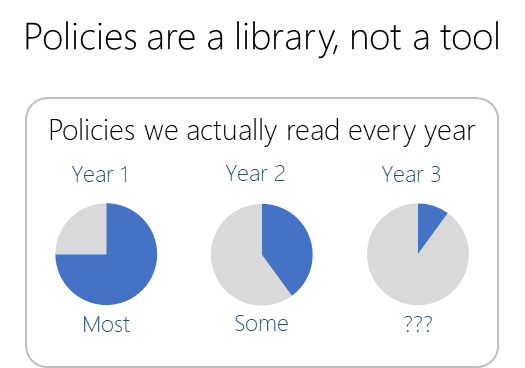
Policies library not a tool

Don't spend too much time on perfecting hundreds of policies. it is more important to focus on whether staff understand and actually apply the priciples they have learnt.

How Important are Policies

Regulations hardly change

Most policy "updates" are usually just tweaks in wording and grammar.

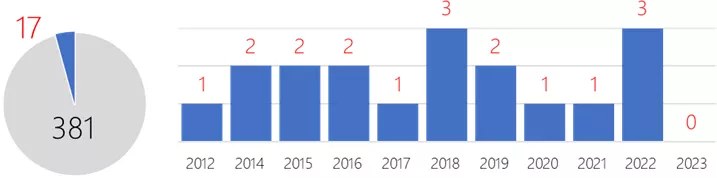
We analysed 10 years of legislation to see how many substantive changes there have been since 2012, excluding HR changes.
17 out of a total of 398 new laws affect providers. On average just 1 or 2 per year, and zero in 2023.

Policies 10 years of new laws

LegislationYearRelevance
Health and Care Act 2022 2022 c. 31 All Providers
Approved Premises (Substance Testing) Act 2022 2022 c. 27 Substance Abuse
Down Syndrome Act 2022 2022 c. 18 All Providers
Botulinum Toxin and Cosmetic Fillers (Children) Act 2021 2021 c. 19 All Providers
Coronavirus Act 2020 2020 c. 7 All Providers
Mental Capacity (Amendment) Act 2019 2019 c. 18 All Providers
Organ Donation (Deemed Consent) Act 2019 2019 c. 7 Hospitals
Health and Social Care (National Data Guardian) Act 2018 2018 c. 31 All Providers
Mental Health Units (Use of Force) Act 2018 2018 c. 27 Hospitals
Assaults on Emergency Workers (Offences) Act 2018 2018 c. 23 Ambulance
Children and Social Work Act 2017 2017 c. 16 Adult Social Care
Immigration Act 2016 2016 c. 19 All Providers
NHS (Charitable Trusts Etc) Act 2016 2016 c. 10 Hospitals
Health Service Commissioner for England (Complaint Handling) Act 2015 2015 c. 29 All Providers
Health and Social Care (Safety and Quality) Act 2015 2015 c. 28 All Providers
Care Act 2014 2014 c. 23 All Providers
Immigration Act 2014 2014 c. 22 All Providers
Mental Health (Approval Functions) Act 2012 2012 c. 18 All Providers

CQC says they're not that interested

Is it about policies?

"Absolutely not. We are much less interested in policies and protocols than in knowing what care is like for your patients, whether staff know what to do about things like child protection, and so on. Good practices shouldn't need to do anything they aren't already doing."

Professor David Haslam, National Clinical Adviser to the Care Quality Commission
(Interview in Healthcare Leader News May 2012)

"We won't normally spend a great deal of time reading policy or procedure documents, unless we need to look at them to substantiate other evidence or what staff or patients have told us about their experiences."

James Hedges, media officer at the CQC (statement to MDDUS May 2013)

This is where the CQC focus their inspections:-

  • Experiences people have when they receive care and the impact the care has on their health and well-being.
  • Talking to patients, their families and their carers.
  • Looking at records or speaking with staff and how they reach their judgements.

British Medical Association says don't bother with large numbers

Question: Is 'CQC' all about policies and protocols?

What the BMA says:

"We believe that most providers will already be compliant with the essential standards" and "CQC registration should not involve the development of large numbers of new policies and protocols."

Extracts from the BMA CQC Registration guidance for GPs.


Does the CQC have a checklist of Polices

No, nobody does.

  1. CQC does not have a list or even a recommended list
  2. Every supplier makes up their own list

What do Inspectors use?

  • The CQC does not have any central list of policies that they expect to see and does not issue any guidance to local inspectors on this.
  • So although EVERY Inspector asks to see your collection of policies and examine individual ones as they see fit, they have no central library to refer to or have any guidance on what to look for to determine what constitutes an acceptable policy.
  • Basically, every inspector makes up their own list and asks for whatever they think is necessary.

Why this matters:

The Policies are requested as evidence during the Inspection, but this varies from inspector to inspector, and effectively allows each inspector to make up their own rules on what is relevant to let you pass. This makes inspections inconsistent and creates uncertainty for Providers as to what they need to have to pass.


You don't need to customise Policies, CQC confirms

A common myth is that Providers must customise their policies

This is what the CQC says: ".....this does not mean providers must necessarily customise policies in order to comply with the regulations".
However, it does not help that Inspectors often contradict this by commenting that you should customise policies.

How people read this:
I should add my logo and name to show it is for my organisation
I should change the wording and add names of Officers so it looks customised for me

What it really means:
Customise it to your particular circumstances IF NECESSARY
Otherwise, it is ok to use the standard best practice policy template


Does the CQC have guidance on Policies to pass an inspection

When the CQC routinely asks for your list of policies, Providers are rightly intimidated into rushing to buy a massive library of policies, most of which they'll never use.

CQC again overemphasises Polices at Registration and before every Inspection
Most smaller providers are being persuaded to purchase from 300 to 600 policies under fear that any one of these may be demanded by a CQC Inspector. In the absence of a defined and definitive checklist, the time cost of maintaining such a number is estimated at in excess of £56.25 million for GPs and £187.5 million in Adult Social Care.

We asked the CQC: Do you have any guidance on essential Policies needed to pass CQC

Question: Please state if the CQC has a definitive guide as to the essential policies required for a provider to successfully pass an inspection.
Answer: CQC do not have a definitive guide as to the essential policies required

Supplementary Question: If such a guide is not available, please state whether the CQC inspectorate is prepared to enter into a mutually beneficial discussion of this initiative with our membership.
Answer: Not yet answered (since 2016)


How many policies do you need

This depends on the size of your organisation and the purpose of your policies.
This is what you should aim to have for a typical organisation with less that 50 staff:-

CQC Policies 20 to 30
HR 5 to 10
Health & Safety 5 to 10
Admin 5 to 10

For larger organisations, the numbers might go up by say 20% due to the complexities of dealing with stricter and more centralised systems.

Minimise the number of policies

  1. Focus on key policies and get them right
  2. A common sense approach to safety will cover most unusual situations
  3. It is better to invest time in developing staff and instilling common sense
  4. Do not overwhelm staff with paperwork to cover every eventuality.

What suppliers won't tell you about costs

What is available

  1. Simple downloadable package: Typically £300 or less. Gives you over 500 policies, procedures, protocols, letters, forms and template documents
  2. Online systems with staff activity logs. Typically £1,000 - £2,000 per annum with over 1,000 pages of guidance

Typical operational costs

  • Time to read every policy: Between one and three solid months, that's why most don't bother.
  • Online systems are efficient for staff tracking, but also add in time to manage and then test knowledge
  • Time to brief all the staff and testing their knowledge typically costs around £15,000 for a small organisation

Saving time and money

  • Publishers would go out of business if they told you that you only need 50 policies and that hardly anything really changes each year.
  • You do not need a policy for every occasion, common sense application of a standard policy often does the job
  • If you are buying this as a useful reference library, be discerning in how you use the material

Common Pitfalls with Policies

How providers use policies

Policy centric systems are labour intensive, and a typical manager would never spend 3 months solid to review their package.

Most providers only read a small fraction of this collection.
Yourr investment is a simple backup library in case the inspector asks. In reality they seldom do.

Purchase cost Vs Real cost

Printable package in Word or PDF format can cost as little as £250, and online systems upwards of £1,500 per annum.
If you manage these systems as intended, the typical management time cost can be around £15,000 per annum.
In reality, hardly anyone bothers to read these thoroughly, and use this purely as a resource library.

General advice

A typical provider with less than 50 full time equivalent staff does not need more than 30-40 core policies.

3 Stages to complacency

The more complex and verbose your policies, the more difficult it is to maintain them

Let's face it, Policies are boring! Most Managers start with enthusiasm, which fades over time

  1. Enthusiasm stage - Motivated to create the "best policies"
  2. Complacency stage - Can't find the time to go through it all again
  3. Redundancy stage - So out of date, you'll have to start all over again

Avoid this by having minimal and minimalist policies that are easy to review and update


Simplify your policies

Most organisations have a comprehensive multi-page document to cover everything. This makes it complicated to understand especially for front line staff.

Policies

  • Policies are statements of intent i.e. "What we are aiming for"

  • They do not say HOW we will do this
  • Policies generally do not require customisation

Procedures and protocols

  • These define how we will implement the policies, i.e. the rules and methodology for people to follow

  • These may be more detailed and will vary with every organisation as each works slightly differently to others

Customisation affects management side more than staff side. e.g. staff usually pass over complaints to managers, job done, whereas Managers will have to define who will handle the investigation and who will have the final say

How to simplify policies

  1. Don't complicate it for staff.
  2. The only person who really needs to know the detailed process or protocol is the line manager.
  3. For staff, differentiate between MUST know Vs USEFUL to know

Make your policies more efficient

Separate and differentiate the functions:-

Separate policies for CQC compliance Vs admin and HR

CQC don't need to see your holidays policy

Simplifying staff policies saves their time and makes it easier to understand and retain knowledge

Differentiate Staff-side polices Vs Management-side policies

Make it easier to explain and understand what we are aiming for Vs how to do things

Restructure your policies:-

  1. Common practice is to insert the name of a responsible person in each policy. DON'T DO THIS.
  2. Enter just the job title of the person e.g. "Fire Marshall"
  3. Then, create a Responsible Persons chart and pin it on every notice board

Now you don't have to edit your policies AND you have a central chart always accessible to staff.

Implementation:-

  1. Review the policies
  2. Customise them ONLY where appropriate
  3. Ensure staff actually absorb and understand
  4. Test staff knowledge regularly
  5. Keep a record of staff training/reading of policies

What NOT to do

Here are some 3 simple tips to keep things under control

  1. 300 policies are great as a reference library but don't treat them all as frontline policies
  2. Unnecessary policies waste time. The hundreds of cheap policies you got would take a solid 3 months to review
  3. The more policies you have, the more stressful the job becomes, minimise to essential policies only

Sharing Policies - Copyright Issues

It is not uncommon for Providers to share their policies.

Exercise care that you are not dealing with copyrighted material.
An infringement may put your professional standing at risk, threaten a criminal record, and may even risk your registration.

  • You cannot copy and distribute without permission
  • You cannot sell it to others
  • You cannot claim it is your own work, only your edits belong to you
  • Deliberate infringement of copyright may be a criminal offence.

Best Practice

  • Always ask where they got these from, and if it is subject to copyright.
  • Get your policies from a legitimate source
  • Remember that copyrighted material always belongs to the author, even when you paid for it.

Getting Started with Policies

Everyone starts with policies as this is the easiest to understand.
Yes, you do need policies but this is only the first step in your compliance. The major part is continuous compliance and evidence.

How to make policies work in CQC

  1. Prioritise important policies, review these more often
  2. Only customise them where appropriate
  3. Get staff to read and understand key policies
  4. Test staff knowledge, better done through discussions
  5. Keep a record of staff training/reading of policies
  6. Keep these up to date, and keep staff informed

How often should I update policies

Most policies will not change from year to year, and this is why:-

  • Regulations hardly change
  • There is minimal new legislation every year
  • Best practice hardly changes on most issues
  • A policy is a statement of intent, this hardly changes

It is important to review your policies on a regular basis
Focus on important and relevant topics and avoid wholesale reviews just for show.
As an example, the ban on smoking came into force on 1st July 2007, and there has been no change to the "policy" of not allowing people to smoke in your building. The number of new regulatory changes actually average less than 2 per year.


This is what the HSE (Health and Safety Executive) Says
  • PAT Tests are not compulsory
  • There is no Annual Testing Requirement
  • There is no need to pay for most testing
  • The only Tools you need are a Risk Assessment and Common Sense
HSE logo

Make use of the HSE website. It is incredibly easy to follow, it is FREE, and has hundreds of useful guides and checklists in plain English


These myths might surprise you

Most routine Health and Safety is about Common Sense and awareness

  • There is no legal requirement to do a PAT Test - It is not compulsory
  • There is no requirement to do it Annually – you have to decide what's best
  • There is no legal requirement to keep a record – but this is good for evidence of compliance
  • There is no legal requirement to label equipment as tested – but this is a good idea
  • You do not need an electrician to test low risk items – a visual and common sense check is enough

All this is HSE's official guidance


What is PAT (Portable Appliance Testing)?

This is what the Health and Safety Executive says

Portable appliance testing (PAT) is the term used to describe the examination of electrical appliances and equipment to ensure they are safe to use.
Most electrical safety defects can be found by visual examination but some types of defect can only be found by testing. However, it is essential to understand that visual examination is an essential part of the process because some types of electrical safety defect can't be detected by testing alone.

A relatively brief user check (based upon simple training and perhaps assisted by the use of a brief checklist) can be a very useful part of any electrical maintenance regime.
However, more formal visual inspection and testing by a competent person may also be required at appropriate intervals, depending upon the type of equipment and the environment in which it is used.


What does the law say?

The Electricity at Work Regulations 1989
This requires that any electrical equipment that has the potential to cause injury is maintained in a safe condition.

The Regulations do not specify what needs to be done, by whom or how frequently and it is left to the organisation to decide the level of maintenance needed according to the risk of an item becoming faulty.

  • They don't make inspection or testing of electrical appliances a legal requirement
  • They do not make it a legal requirement to undertake this annually.

HSCA Regulation 12: safe care and treatment
Paragraph 2 (e) requires you to ensure that "the equipment used by the service provider for providing care or treatment to a service user is safe for such use and is used in a safe way"


Are annual PAT inspections neccessary?

There is no "Annual Inspection" requirement.

  • The Regulations only require you to ensure that electrical equipment is maintained in a safe condition.
  • They do not specify what needs to be done, by whom or how frequently.
  • Your organisation can decide the level of maintenance needed according to the risk of an item becoming faulty.

You can do most inspections and assessments yourself, there is no need to pay a "professional" to do these on low risk items.
The frequency of checks is a matter of judgement and common sense, as long as you check these on a regular basis. You might want to check critical equipment or older equipment more often, and newer equipement on a less regular basis.

Most Risk assesments can be done by staff, this encourages self-responsibility and awareness of risk.


Is PAT testing compulsory?

No, PAT testing is not compulsory.

In April 2012 the HSE revised its guidance on 'Maintaining portable electric equipment in low risk environments'. and recommend that employers should take a risk-based approach, considering the type of equipment and what it is being used for. If it is used regularly and moved a lot e.g. a floor cleaner or a kettle, testing (along with visual checks) can be an important part of an effective maintenance regime giving employers confidence that they are doing what is necessary to help them meet their legal duties.

In addition to "safe to use" test, these are things you should consider when assessing risk:

  • Is the equipment being used correctly,
  • Is it suitable for the job, and
  • is it being used in a harsh environment

Staff engagement is critical

Something that was safe 10 minutes ago may well have become dangerous right now

  • Any check you do only proves that the equipment was fit for purpose on that date
  • Things can get damaged and dislodged during use
  • Over-reliance on anuual checks is not best practice and not in your best interest

Staff Participation

You should always have a Responsible Officer for overall management
However, it is impossible for that one person to supervise everything that everyone does. People have to be responsible for their own safety.

  • An organisation works better with teamwork and a shared burden
  • Staff on the front lines are better placed to manage their own safety
  • Educating staff is simple - Tell them their lives depend on the safety checks they carry out
  • A culture of self-responsibility creates a better workplace, delivers better service and makes everyone's life easier

Keep reminding staff that they are the best experts we have to ensure safety on a daily basis


Annual Vs Daily checks

Just because it was safe in January does not mean it is still safe in July.

An annual check is just a spot check, not a guarantee that it will stay safe for the rest of the year.

User Checks
The check should be carried at the time of use by the person using equipment. This involves a visual inspection of the mains plug, cable and the appliance for obvious signs of damage or degradation.


Regular Visual Inspections

Formal Visual Inspection
These should be carried out at set intervals by a competent person to look for any defects.

Hazards that can be identified through a visual inspection:

  • Enclosure damage
  • Damage to the mains flex
  • Signs of overheating
  • Incorrectly fitted mains plugs
  • Incorrect fuses (where visible)

Hazardous equipment should be removed from usage, or unplugged and warning signs attached if appropriate.
The findings of these checks should be recorded and kept as evidence and more importantly how this was fixed.
These requirements will vary according to the equipment being inspected and the environment in which it is used.


Combined Inspection and Testing

Combined Inspection and Testing

Specialist equipment will often require maintenance and testing by a trained professional, a qualified electrician or service engineer.
For example: Clinical equipment requires both testing and calibration on a regular basis by a manufacturer accredited engineer.

Staff should always carry out visual checks during usage, but you can never skip professional servicing and calibration.


Testing new equipment

New equipment would be supplied in a safe condition and does not require a formal portable appliance inspection or test.

It is good practice to carry out a quick visually inspection before use in case there is a defect or damage in transit.


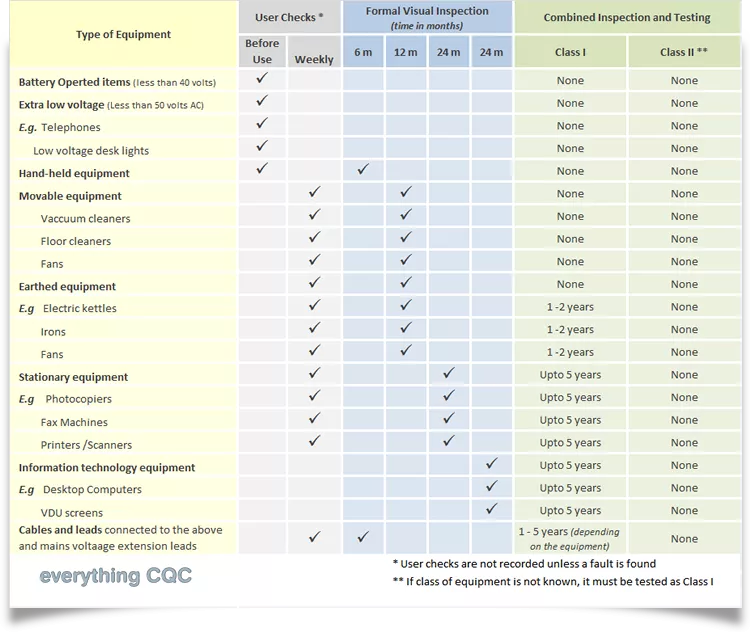
Suggested intervals for checking electrical equipment

The frequency of inspection and testing depends upon the type of equipment and the environment it is used in.

For example, a power tool used on a construction site should be examined more frequently than a lamp in a hotel bedroom.

Frequency of PAT tests


Medical Equipment

Medical devices are tested to completely different standards to domestic, commercial and industrial appliances in the general workplace.
The specialist PAT tests for medical equipment take into account not just safety but also test specific functionality of the equipment, calibration and accuracy.

Frequency for testing for medical equipment

  • Routine Testing: Usually carried out at fixed time intervals, and will vary between types of equipment (Check with the manufacturer for guidance)
  • After Service & Repair Testing; Carried out following a repair or product upgrade, before the item is put into service

Medical Electrical Safety Testing should always be carried out by a qualified and trained professional.


Instant Solution: Risk Assessment

Go to My Toolkts and look for these under Evidence Toolkits (Section 6 - Safety)

  • 6 Pat Test – Combined Review
  • 6 Pat Test – Formal Visual checks

These Toolkits identify risks associated with Portable Appliances

HSE logo

Associated Toolkits: Hazard Reviews and Hazard Management Toolkits also under Section 6 - Safety

SOLE TRADERS TO ENTERPRISES

Scalable solutions suitable for Providers of any size and trusted by well known brand names

customers NHS Nottingham Trust
customers ambient
customers livability
customers london medical
customers nuffield
customers qinetic
customers pearl chemist
customers renovo
customers ucl
customers vision
customers Berkshire Primary Care
customers Care at home
customers Circle health group
customers Cromwell hospital
customers Cygnet healthcare
customers NHS Halcyon Medical
customers NHS South West Yorkshire
customers NHS Torbay and south devon
customers North Hampshire urgent care
customers Nuffield health
customers Priory
customers Spire Bushy hospital
customers Trust Care Ltd
customers Urgent care Primary care 25
customers Winfield hospital
×

Login to your account

Don't have an account? Register Now