Why no one reads the Outcomes
CQC Regulations came into force from 1st April 2013, and CQC inspections are underway; however it is considered that up to 95% of practices may not have read the CQC Guidelines yet.
The registration process asked practices to certify that they meet the compliance standards set under the CQC regime, and practices are required to have made themselves familiar with the CQC Guidelines issued by the Care Quality Commission.
Although every practice has certified that they are compliant or that they have an action plan in place, alarmingly, anecdotal evidence suggests that up to 95% of Practice managers may not even have read the CQC guidance.
“We were the first independent organisation to hold CQC seminars for GP practices, and when we asked this question in 2011, hardly any hands went up” said Shabana Dehlavi, the editor of Everything CQC, the popular CQC resource site for GP Practices. “But what will be surprising to many is that the same applies, even today”.
If these straw polls were to be extrapolated to the general GP population, it would indicate that up to 95% of the practices have not read the Guidelines or gave up part of the way through, usually after reading just the first few pages. So if you too have not read the CQC Essential Guidance then it looks like you are in good company.
Most providers find the Guideline a difficult read because of the ‘bureaucratic’ language used. Trying to ‘decipher’ the meaning of a single sentence can sometimes take quite some time, and most just give up mentally exhausted.
An example of this language is Prompt 3E about Fees, to be found on page 59 of the Guideline.
Contrast what the Guideline says:
“People who use services who pay the provider in full for their care, treatment and support and people who use services who enter into a separate arrangement with a service provider because they choose to pay for care, treatment and support that is not contracted on their behalf by a third party purchaser…”
With what it means in plain English:
“If the patient pays for the entire treatment out of their own pocket, then …...”
The Guideline, is some 278 pages long, and it is not difficult to see why readers describe it as a cure for insomnia.
On a serious note, without a full understanding what the requirements are, practices are in danger of mis-declarations, and carrying on doing the wrong things for the rest of the year. This should be of great concern to GPs, especially Registered Managers, who may be held accountable.
The NAPC supports this resource, and members who are concerned should make a bee line for www.EverythingCQC.com as this plain English guide is designed to educate and inform, and explains once again in plain English, the easiest and most painless route to keeping the house in order.
Essential Outcomes
The 16 core essential outcomes:
Chapter |
Outcome |
Title |
Summary of Outcome |
| Involvement & Information | 1 | Respecting and involving people who use services | People understand the care and treatment choices available to them. They can express their views and are involved in making decisions about their care. They have their privacy, dignity and independence respected, and have their views and experiences taken into account in the way in which the service is delivered. |
| 2 | Consent to care and treatment | People give consent to their care and treatment, and understand and know how to change decisions about things that have been agreed previously. | |
| Personalised care, treatment and support | 4 | Care and welfare of people who use services | People experience effective, safe and appropriate care, treatment and support that meets their needs and protects their rights. |
| 5 | Meeting nutritional needs | People are encouraged and supported to have sufficient food and drink that is nutritional and balanced, and a choice of food and drink to meet their different needs. | |
| 6 | Cooperating with other providers | People receive safe and coordinated care when they move between providers or receive care from more than one provider. | |
| Safeguarding and Safety | 7 | Safeguarding people who use services from abuse | People are safeguarded from abuse, or the risk of abuse, and their human rights are respected and upheld. |
| 8 | Cleanliness and infection control | People experience care in a clean environment, and are protected from acquiring infections. | |
| 9 | Management of medicines | People have their medicines when they need them, and in a safe way. People are given information about their medicines. | |
| 10 | Safety and suitability of premises | People receive care in, work in or visit safe surroundings that promote their wellbeing. | |
| 11 | Safety, availability and suitability of equipment | Where equipment is used, it is safe, available, comfortable and suitable for people’s needs. | |
| Suitability of Staffing | 12 | Requirements relating to workers | People are kept safe, and their health and welfare needs are met, by staff who are fit for the job and have the right qualifications, skills and experience. |
| 13 | Staffing | People are kept safe, and their health and welfare needs are met, because there are sufficient numbers of the right staff. | |
| 14 | Supporting workers | People are kept safe, and their health and welfare needs are met, because staff are competent to carry out their work and are properly trained, supervised and appraised. | |
| Quality and Management | 16 | Assessing and monitoring the quality of service provision | People benefit from safe, quality care because effective decisions are made and because of the management of risks to people’s health, welfare and safety. |
| 17 | Complaints | People and those acting on their behalf have their comments and complaints listened to and acted on effectively, and know that they will not be discriminated against for making a complaint. | |
| 21 | Records | People’s personal records are accurate, fit for purpose, held securely and remain confidential. The same applies to other records that are needed to protect their safety and wellbeing. |
(To print a Quick Guide to the 28 outcomes CLICK HERE)
What's New
Contrary to popular belief, CQC is actually nothing new. Most of the regulations have been in force for some time. We have done a quick graphic below to stop you having palpitations.
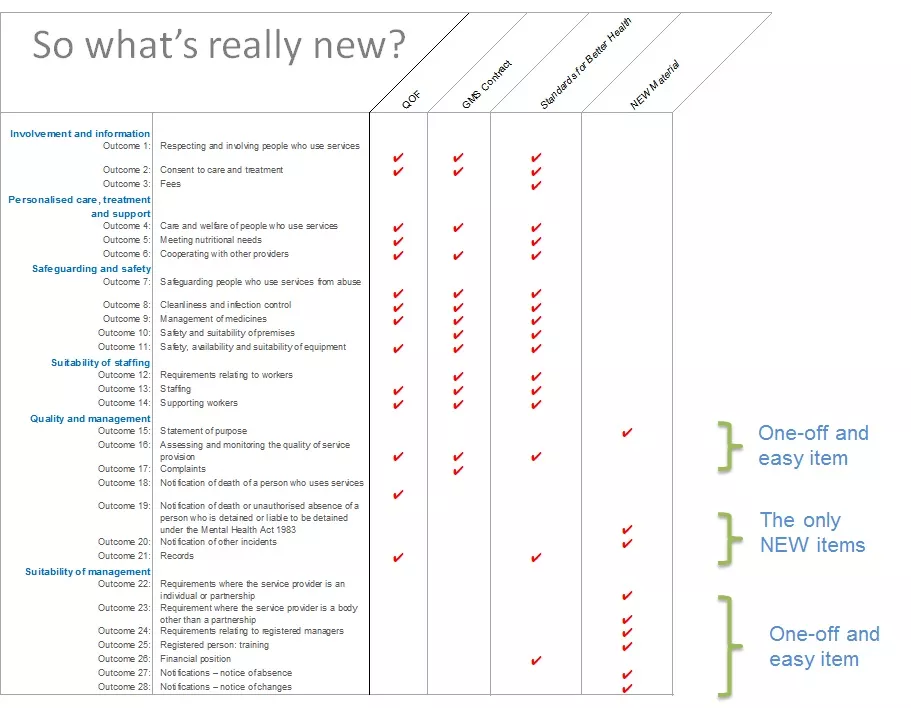
As we explain further on, the biggest change is that the emphasis is moving towards proving that you are meeting compliance on a day to day basis, rather than just knowing what to do.
A Shakey Start
The new inspection regime started on 1st October 2014, but slipped under the radar of most practices because the CQC followed a confusing sequence on the consultation.
- June 2014 - Last date for submissions to the consultation process.
- September 2014 - Publication of Final Version of the Guidelines (Actually published on 9th October 2014)
- 1st October 2014 - Start date for the new regime.
- April 2015 - Changes came into effect (although the new regime had already started)
Why Registered Managers were confused:-
- They thought that the new regime of inspections would start AFTER the Final Guidelines were published.
- Most managers thought the changes come into play in April 2015 not October 2014, and they had plenty of time.
- Even if the CQC had met its own deadline for publication, managers had virtually no time at all to read about the changes.
- Even after the publication, pages on the CQC web site still carried out of date and misleading information to confuse readers.
Editor's Note: This article has been updated since original publication on the 9th to take into account new announcements made by the CQC on the same day.