



- PAT Tests are not compulsory
- There is no Annual Testing Requirement
- There is no need to pay for most testing
- The only Tools you need are a Risk Assessment and Common Sense

Make use of the HSE website. It is incredibly easy to follow, it is FREE, and has hundreds of useful guides and checklists in plain English
PAT Test Basics
These myths might surprise you
Most routine Health and Safety is about Common Sense and awareness
- There is no legal requirement to do a PAT Test - It is not compulsory
- There is no requirement to do it Annually – you have to decide what's best
- There is no legal requirement to keep a record – but this is good for evidence of compliance
- There is no legal requirement to label equipment as tested – but this is a good idea
- You do not need an electrician to test low risk items – a visual and common sense check is enough
All this is HSE's official guidance
What is PAT (Portable Appliance Testing)?
This is what the Health and Safety Executive says
Portable appliance testing (PAT) is the term used to describe the examination of electrical appliances and equipment to ensure they are safe to use.
Most electrical safety defects can be found by visual examination but some types of defect can only be found by testing. However, it is essential to understand that visual examination is an essential part of the process because some types of electrical safety defect can't be detected by testing alone.
A relatively brief user check (based upon simple training and perhaps assisted by the use of a brief checklist) can be a very useful part of any electrical maintenance regime.
However, more formal visual inspection and testing by a competent person may also be required at appropriate intervals, depending upon the type of equipment and the environment in which it is used.
No Legal Requirement
What does the law say?
The Electricity at Work Regulations 1989
This requires that any electrical equipment that has the potential to cause injury is maintained in a safe condition.
The Regulations do not specify what needs to be done, by whom or how frequently and it is left to the organisation to decide the level of maintenance needed according to the risk of an item becoming faulty.
- They don't make inspection or testing of electrical appliances a legal requirement
- They do not make it a legal requirement to undertake this annually.
HSCA Regulation 12: safe care and treatment
Paragraph 2 (e) requires you to ensure that "the equipment used by the service provider for providing care or treatment to a service user is safe for such use and is used in a safe way"
Are annual PAT inspections neccessary?
There is no "Annual Inspection" requirement.
- The Regulations only require you to ensure that electrical equipment is maintained in a safe condition.
- They do not specify what needs to be done, by whom or how frequently.
- Your organisation can decide the level of maintenance needed according to the risk of an item becoming faulty.
You can do most inspections and assessments yourself, there is no need to pay a "professional" to do these on low risk items.
The frequency of checks is a matter of judgement and common sense, as long as you check these on a regular basis. You might want to check critical equipment or older equipment more often, and newer equipement on a less regular basis.
Most Risk assesments can be done by staff, this encourages self-responsibility and awareness of risk.
Is PAT testing compulsory?
No, PAT testing is not compulsory.
In April 2012 the HSE revised its guidance on 'Maintaining portable electric equipment in low risk environments'. and recommend that employers should take a risk-based approach, considering the type of equipment and what it is being used for. If it is used regularly and moved a lot e.g. a floor cleaner or a kettle, testing (along with visual checks) can be an important part of an effective maintenance regime giving employers confidence that they are doing what is necessary to help them meet their legal duties.
In addition to "safe to use" test, these are things you should consider when assessing risk:
- Is the equipment being used correctly,
- Is it suitable for the job, and
- is it being used in a harsh environment
Best Practice for PAT Tests
Staff engagement is critical
Something that was safe 10 minutes ago may well have become dangerous right now
- Any check you do only proves that the equipment was fit for purpose on that date
- Things can get damaged and dislodged during use
- Over-reliance on anuual checks is not best practice and not in your best interest
Staff Participation
You should always have a Responsible Officer for overall management
However, it is impossible for that one person to supervise everything that everyone does. People have to be responsible for their own safety.
- An organisation works better with teamwork and a shared burden
- Staff on the front lines are better placed to manage their own safety
- Educating staff is simple - Tell them their lives depend on the safety checks they carry out
- A culture of self-responsibility creates a better workplace, delivers better service and makes everyone's life easier
Keep reminding staff that they are the best experts we have to ensure safety on a daily basis
Annual Vs Daily checks
Just because it was safe in January does not mean it is still safe in July.
An annual check is just a spot check, not a guarantee that it will stay safe for the rest of the year.
User Checks
The check should be carried at the time of use by the person using equipment. This involves a visual inspection of the mains plug, cable and the appliance for obvious signs of damage or degradation.
Regular Visual Inspections
Formal Visual Inspection
These should be carried out at set intervals by a competent person to look for any defects.
Hazards that can be identified through a visual inspection:
- Enclosure damage
- Damage to the mains flex
- Signs of overheating
- Incorrectly fitted mains plugs
- Incorrect fuses (where visible)
Hazardous equipment should be removed from usage, or unplugged and warning signs attached if appropriate.
The findings of these checks should be recorded and kept as evidence and more importantly how this was fixed.
These requirements will vary according to the equipment being inspected and the environment in which it is used.
Combined Inspection and Testing
Combined Inspection and Testing
Specialist equipment will often require maintenance and testing by a trained professional, a qualified electrician or service engineer.
For example: Clinical equipment requires both testing and calibration on a regular basis by a manufacturer accredited engineer.
Staff should always carry out visual checks during usage, but you can never skip professional servicing and calibration.
Testing new equipment
New equipment would be supplied in a safe condition and does not require a formal portable appliance inspection or test.
It is good practice to carry out a quick visually inspection before use in case there is a defect or damage in transit.
How Often
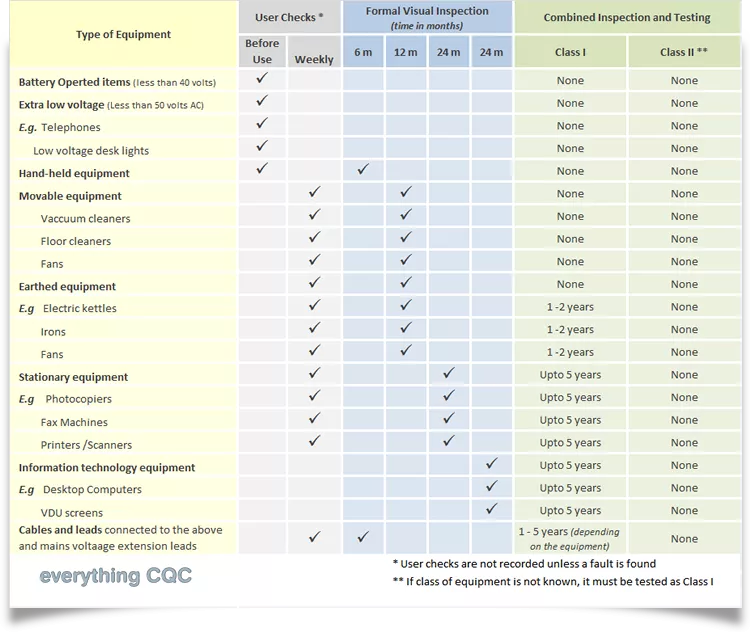
Suggested intervals for checking electrical equipment
The frequency of inspection and testing depends upon the type of equipment and the environment it is used in.
For example, a power tool used on a construction site should be examined more frequently than a lamp in a hotel bedroom.
Medical Equipment
Medical devices are tested to completely different standards to domestic, commercial and industrial appliances in the general workplace.
The specialist PAT tests for medical equipment take into account not just safety but also test specific functionality of the equipment, calibration and accuracy.
Frequency for testing for medical equipment
- Routine Testing: Usually carried out at fixed time intervals, and will vary between types of equipment (Check with the manufacturer for guidance)
- After Service & Repair Testing; Carried out following a repair or product upgrade, before the item is put into service
Medical Electrical Safety Testing should always be carried out by a qualified and trained professional.
Instant Solution: Risk Assessment
Go to My Toolkts and look for these under Evidence Toolkits (Section 6 - Safety)
- 6 Pat Test – Combined Review
- 6 Pat Test – Formal Visual checks
These Toolkits identify risks associated with Portable Appliances
Associated Toolkits: Hazard Reviews and Hazard Management Toolkits also under Section 6 - Safety